新唐
Chinese retirees are turning hard-won time into journeys once confined to maps and documentaries_我的网站

一 | Editor's Note:
With China's population of seniors over 60 surpassing 300 million, ensuring a happy and fulfilling life for all seniors has become a pressing issue for both families and the nation. How can the new generation of seniors in China break away from traditional norms and embrace a different lifestyle, supported by AI technology, multiculturalism and an elder-friendly society?
The series "Old Age, New Trends" explores emerging trends in the silver economy, creative social norms among senior citizens and innovative eldercare services. It examines the opportunities and challenges presented by an aging society, highlighting the diverse lifestyles of seniors and the booming eldercare industry in China. Beneath these new trends lies a reflection of Chinese modernization, which aims to provide more secure systems and dignified lives for its senior population.

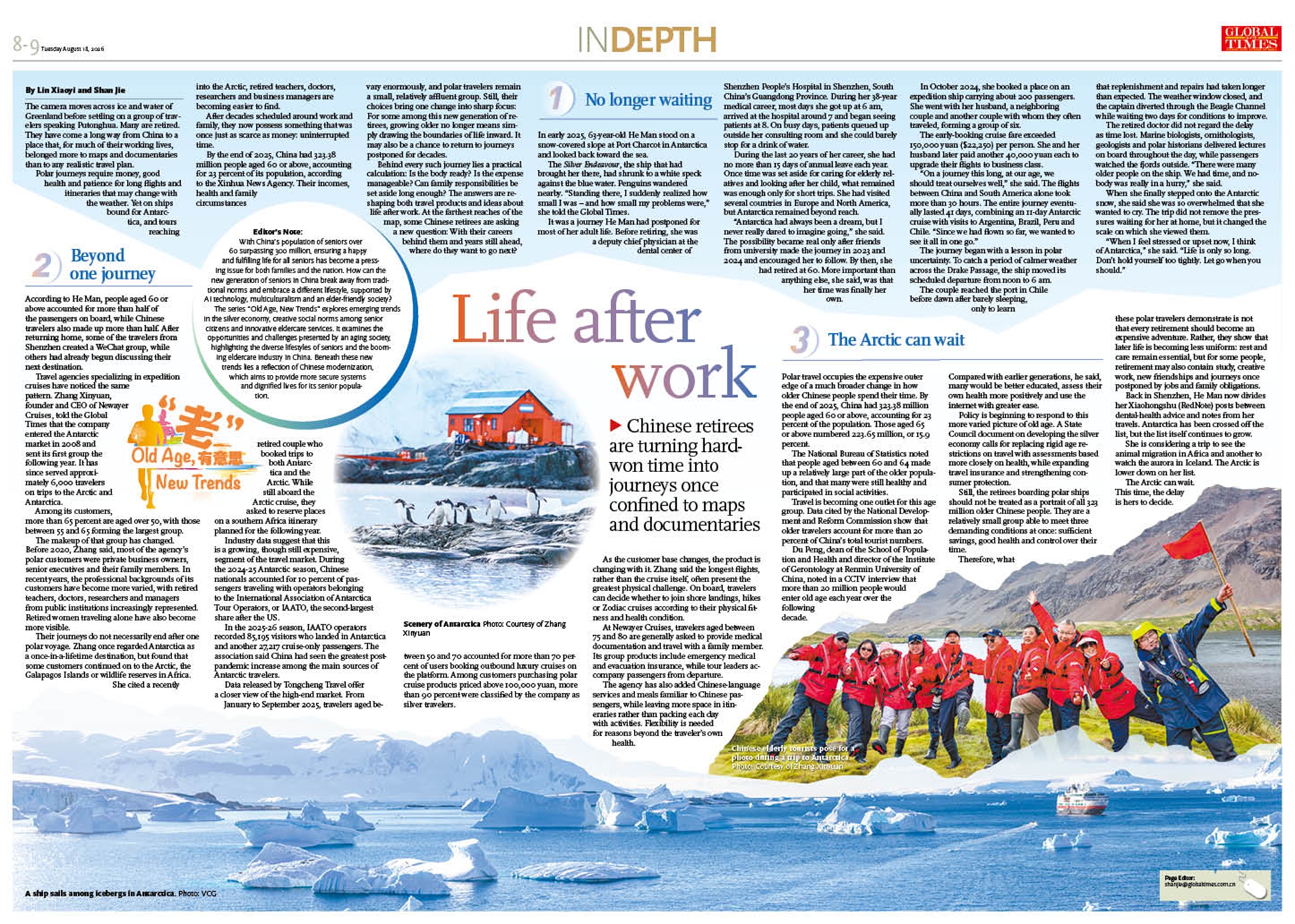
Chinese elderly tourists pose for a photo during a trip to Antarctica. Photo: Courtesy of Zhang XinyuanThe camera moves across ice and water of Greenland before settling on a group of travelers speaking Putonghua. Many are retired. They have come a long way from China to a place that, for much of their working lives, belonged more to maps and documentaries than to any realistic travel plan.
Polar journeys require money, good health and patience for long flights and itineraries that may change with the weather. Yet on ships bound for Antarctica, and tours reaching into the Arctic, retired teachers, doctors, researchers and business managers are becoming easier to find.
After decades scheduled around work and family, they now possess something that was once just as scarce as money: uninterrupted time.
By the end of 2025, China had 323.38 million people aged 60 or above, accounting for 23 percent of its population, according to the Xinhua News Agency. Their incomes, health and family circumstances vary enormously, and polar travelers remain a small, relatively affluent group. Still, their choices bring one change into sharp focus: For some among this new generation of retirees, growing older no longer means simply drawing the boundaries of life inward. It may also be a chance to return to journeys postponed for decades.
Behind every such journey lies a practical calculation: Is the body ready? Is the expense manageable? Can family responsibilities be set aside long enough? The answers are reshaping both travel products and ideas about life after work. At the farthest reaches of the map, some Chinese retirees are asking a new question: With their careers behind them and years still ahead, where do they want to go next?
No longer waitingIn early 2025, 63-year-old He Man stood on a snow-covered slope at Port Charcot in Antarctica and looked back toward the sea.
The Silver Endeavour, the ship that had brought her there, had shrunk to a white speck against the blue water. Penguins wandered nearby. "Standing there, I suddenly realized how small I was - and how small my problems were," she told the Global Times.
It was a journey He Man had postponed for most of her adult life. Before retiring, she was a deputy chief physician at the dental center of Shenzhen People's Hospital in Shenzhen, South China's Guangdong Province. During her 38-year medical career, most days she got up at 6 am, arrived at the hospital around 7 and began seeing patients at 8. On busy days, patients queued up outside her consulting room and she could barely stop for a drink of water.
During the last 20 years of her career, she had no more than 15 days of annual leave each year. Once time was set aside for caring for elderly relatives and looking after her child, what remained was enough only for short trips. She had visited several countries in Europe and North America, but Antarctica remained beyond reach.
"Antarctica had always been a dream, but I never really dared to imagine going," she said. The possibility became real only after friends from university made the journey in 2023 and 2024 and encouraged her to follow. By then, she had retired at 60. More important than anything else, she said, was that her time was finally her own.
In October 2024, she booked a place on an expedition ship carrying about 200 passengers. She went with her husband, a neighboring couple and another couple with whom they often traveled, forming a group of six.
The early-booking cruise fare exceeded 150,000 yuan ($22,250) per person. She and her husband later paid another 40,000 yuan each to upgrade their flights to business class.
"On a journey this long, at our age, we should treat ourselves well," she said. The flights between China and South America alone took more than 30 hours. The entire journey eventually lasted 41 days, combining an 11-day Antarctic cruise with visits to Argentina, Brazil, Peru and Chile. "Since we had flown so far, we wanted to see it all in one go."
The journey began with a lesson in polar uncertainty. To catch a period of calmer weather across the Drake Passage, the ship moved its scheduled departure from noon to 6 am.
The couple reached the port in Chile before dawn after barely sleeping, only to learn that replenishment and repairs had taken longer than expected. The weather window closed, and the captain diverted through the Beagle Channel while waiting two days for conditions to improve.
The retired doctor did not regard the delay as time lost. Marine biologists, ornithologists, geologists and polar historians delivered lectures on board throughout the day, while passengers watched the fjords outside. "There were many older people on the ship. We had time, and nobody was really in a hurry," she said.
When she finally stepped onto the Antarctic snow, she said she was so overwhelmed that she wanted to cry. The trip did not remove the pressures waiting for her at home, but it changed the scale on which she viewed them.
"When I feel stressed or upset now, I think of Antarctica," she said. "Life is only so long. Don't hold yourself too tightly. Let go when you should."

Scenery of Antarctica Photo: Courtesy of Zhang Xinyuan
Beyond one journeyAccording to He Man, people aged 60 or above accounted for more than half of the passengers on board, while Chinese travelers also made up more than half. After returning home, some of the travelers from Shenzhen created a WeChat group, while others had already begun discussing their next destination.
Travel agencies specializing in expedition cruises have noticed the same pattern. Zhang Xinyuan, founder and CEO of Newayer Cruises, told the Global Times that the company entered the Antarctic market in 2008 and sent its first group the following year. It has since served approximately 6,000 travelers on trips to the Arctic and Antarctica.
Among its customers, more than 65 percent are aged over 50, with those between 55 and 65 forming the largest group.
The makeup of that group has changed. Before 2020, Zhang said, most of the agency's polar customers were private business owners, senior executives and their family members. In recent years, the professional backgrounds of its customers have become more varied, with retired teachers, doctors, researchers and managers from public institutions increasingly represented. Retired women traveling alone have also become more visible.
Their journeys do not necessarily end after one polar voyage. Zhang once regarded Antarctica as a once-in-a-lifetime destination, but found that some customers continued on to the Arctic, the Galapagos Islands or wildlife reserves in Africa.
She cited a recently retired couple who booked trips to both Antarctica and the Arctic. While still aboard the Arctic cruise, they asked to reserve places on a southern Africa itinerary planned for the following year.
Industry data suggest that this is a growing, though still expensive, segment of the travel market. During the 2024-25 Antarctic season, Chinese nationals accounted for 10 percent of passengers traveling with operators belonging to the International Association of Antarctica Tour Operators, or IAATO, the second-largest share after the US.
In the 2025-26 season, IAATO operators recorded 85,195 visitors who landed in Antarctica and another 27,217 cruise-only passengers. The association said China had seen the greatest post-pandemic increase among the main sources of Antarctic travelers.
Data released by Tongcheng Travel offer a closer view of the high-end market. From January to September 2025, travelers aged between 50 and 70 accounted for more than 70 percent of users booking outbound luxury cruises on the platform. Among customers purchasing polar cruise products priced above 100,000 yuan, more than 90 percent were classified by the company as silver travelers.
As the customer base changes, the product is changing with it. Zhang said the longest flights, rather than the cruise itself, often present the greatest physical challenge. On board, travelers can decide whether to join shore landings, hikes or Zodiac cruises according to their physical fitness and health condition.
At Newayer Cruises, travelers aged between 75 and 80 are generally asked to provide medical documentation and travel with a family member. Its group products include emergency medical and evacuation insurance, while tour leaders accompany passengers from departure.
The agency has also added Chinese-language services and meals familiar to Chinese passengers, while leaving more space in itineraries rather than packing each day with activities. Flexibility is needed for reasons beyond the traveler's own health.

A ship sails among icebergs in Antarctica. Photo: VCG
The Arctic can waitPolar travel occupies the expensive outer edge of a much broader change in how older Chinese people spend their time. By the end of 2025, China had 323.38 million people aged 60 or above, accounting for 23 percent of the population. Those aged 65 or above numbered 223.65 million, or 15.9 percent.
The National Bureau of Statistics noted that people aged between 60 and 64 made up a relatively large part of the older population, and that many were still healthy and participated in social activities.
Travel is becoming one outlet for this age group. Data cited by the National Development and Reform Commission show that older travelers account for more than 20 percent of China's total tourist numbers.
Du Peng, dean of the School of Population and Health and director of the Institute of Gerontology at Renmin University of China, noted in a CCTV interview that more than 20 million people would enter old age each year over the following decade. Compared with earlier generations, he said, many would be better educated, assess their own health more positively and use the internet with greater ease.
Policy is beginning to respond to this more varied picture of old age. A State Council document on developing the silver economy calls for replacing rigid age restrictions on travel with assessments based more closely on health, while expanding travel insurance and strengthening consumer protection.
Still, the retirees boarding polar ships should not be treated as a portrait of all 323 million older Chinese people. They are a relatively small group able to meet three demanding conditions at once: sufficient savings, good health and control over their time.
Therefore, what these polar travelers demonstrate is not that every retirement should become an expensive adventure. Rather, they show that later life is becoming less uniform: rest and care remain essential, but for some people, retirement may also contain study, creative work, new friendships and journeys once postponed by jobs and family obligations.
Back in Shenzhen, He Man now divides her Xiaohongshu (RedNote) posts between dental-health advice and notes from her travels. Antarctica has been crossed off the list, but the list itself continues to grow.
She is considering a trip to see the animal migration in Africa and another to watch the aurora in Iceland. The Arctic is lower down on her list.
The Arctic can wait. This time, the delay is hers to decide.
。

特斯拉Cybercab定档9月3日发布,国内L3/L4智驾强制性国标也已获批,自动驾驶赛道迎来密集催化。机构普遍看好Robotaxi商业化拐点,产业链有望迎来红利期。
特斯拉Cybercab即将发布 8月22日,特斯拉在X平台宣布,将于当地时间9月3日在奥斯汀举行Cybercab发布活动。据悉,Cybercab彻底取消方向盘、制动踏板和后视镜,采用两座布局,完全依赖特斯拉的FSD(全自动驾驶)系统来行驶。 业内预测,特斯拉或将在本次活动中官宣Cybercab加入Robotaxi服务车队。

二 | 今年6月起,Cybercab已在包括奥斯汀在内的美国多地公共道路测试。目前,特斯拉Robotaxi业务覆盖七大区域,其中2州6城无监督运营,无监督驾驶累计超38万英里,累计付费里程接近250万英里。 国内政策面同样迎来利好。《智能网联汽车自动驾驶系统安全要求》强制性国家标准近日获批发布,拟于2027年7月1日起正式实施。这是首部针对L3级有条件自动驾驶和L4级高度自动驾驶系统的强制性国标,适用于搭载L3级、L4级系统的M类和N类车辆,为自动驾驶产品明确了统一的安全准入基线。 工信部数据显示,目前L2级组合驾驶辅助乘用车渗透率已达70.5%,领航驾驶辅助(NOA)渗透率达34.2%。

三 | Robotaxi商业化同样突飞猛进,8月18日,小马智行发布二季度财报,Robotaxi业务收入8192万元,同比增长691.2%,乘客车费收入同比激增849.3%,创历史最高单季涨幅。该公司近日还与Uber宣布扩大战略合作,计划在欧洲五城部署超2000辆Robotaxi。 机构看好L4商业化元年开启 自动驾驶是指通过感知系统、决策系统和执行系统,使车辆能够在特定场景下无需人类驾驶员干预而自主完成动态驾驶任务的技术。当前,自动驾驶正从技术验证加速迈向规模化商业落地。 据爱建证券推算,Cybercab通过去除方向盘、踏板等部件、采用小电池方案降低整车复杂度,并配合新生产工艺,单车成本已降至2.3万至2.5万美元级别,较同期美国网约车主流车型购置成本低约30%;量产运营成本约0.21至0.25美元/英里,接近传统网约车的20%,为Robotaxi盈利成立的核心支撑。

四 | “2026年是中国智能驾驶从功能竞赛转向制度化商业落地的关键分水岭。”中信建投指出,随着L3从试点走向正式运行,L4相关技术不断成熟,产业坐标已切换至三条主线并行,其中,L4/Robotaxi在中美共振下迈入规模化验证阶段,Robotaxi、智驾芯片、激光雷达均有望充分受益。 在华金证券看来,智驾政策加速完善,L3/L4落地正式有法可依;城市NOA已走完“高端尝鲜”阶段,正式进入“全面普及+规模化渗透”的行业新周期,叠加技术路线不断收敛,逐渐向VLA和世界模型演进,高阶智驾发展迎来拐点,渗透率有望持续提升。 多只概念股业绩有望倍增 东方财富概念板块显示,目前A股市场有297股涉及智能驾驶概念,合计总市值约7.47万亿元。 中际旭创市值达1.1万亿元居首,比亚迪以8248亿元位居次席,海康威视、潍柴动力、沪电股份体量分列三至五位,中国中车、中航成飞、长城汽车等5股市值均超千亿元。
年初至今,智能驾驶概念板块整体走势偏弱,71股上涨、226股下跌。红板科技大涨393%领跑,光智科技涨近3.3倍排名第二,杰华特、长光华芯、泰晶科技等6股也已翻倍。下跌方面,江淮汽车、长安汽车、豪恩汽电、经纬恒润等多达83股均跌逾30%。 本月以来,板块走势有所回暖,共六成概念股录得股价上涨。金禄电子、东田微均大涨近七成,炬光科技涨幅达60%,腾景科技、光智科技等3股月内涨幅均超50%。下跌方面,江淮汽车、赛力斯、北汽蓝谷等7股跌超10%。 从资金角度看,东方财富Choice数据显示,本月以来,共有多达75只智能驾驶概念股获得超千万元融资净买入。 其中,景旺电子、芯原股份分别获杠杆资金加仓5.68亿、5.66亿元,潍柴动力、炬光科技分别获抢筹4.78亿、3.07亿元,睿创微纳、泰晶科技、宇瞳光学均获超2亿元融资净买入,聚辰股份、拓普集团、腾景科技、豪威集团等7股融资净买额均在1.2亿至1.7亿元之间。 未来增长潜力方面,根据3家及以上机构一致预测,共7只智能驾驶概念股2026年业绩有望翻倍增长。

五 | 其中,机构预计炬光科技净利同比大增2.7倍,中际旭创净利将增长超2倍,江淮汽车、睿创微纳等2股预测净利增幅均在1.4倍以上,天准科技、芯原股份、电连技术的业绩亦有望倍增。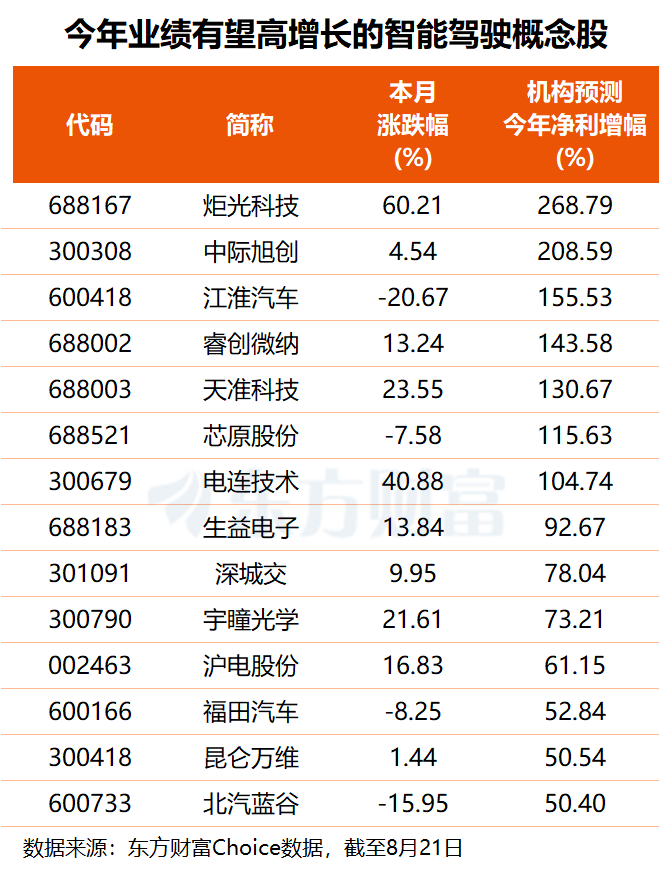 (文章来源:东方财富研究中心)。
Current article:http://dn7r.yofateeikengyeche.cfd/p6qm3h/tnn.html
Published on:17:11:29

 US Pentagon official’s Manila speech exposes alliance fragility, with Philippines likely to bear costs of provocations: Chinese expert
 中宣部版权管理局:2023年我国全年著作权登记总量超892万件 同比增长40.46%
 起亚全新赛图斯车型上市:蔡徐坤代言,一口价 7.99 万元起
 이창흠 제주도 기후경제부지사 후보자 '적합'… 계엄 대응·경제 경험은 숙제
 财政部:7月份全国共销售彩票875.71亿元
 习近平的文化情怀丨“要像爱惜自己的生命一样保护好城市历史文化遗产”
 Media ‘Overplaying’ Trump-Endorsed Hageman’s Primary Victory Over Liz Cheney, Experts Say


