
半斤八两
GT Voice: Bridging digital gap to be decisive factor in global AI competition_我的网站

A |

In a report released on Tuesday, the World Bank made an optimistic assessment that artificial intelligence (AI) could allow developing countries to do in a decade what might otherwise take a century. The report found that AI will throw developing economies a lifeline, and that the technology's greatest promise for developing countries lies not in replacing workers, but in amplifying what they can do.
While advanced economies are still debating whether AI will wipe out white-collar jobs, this report serves as a critical reminder that AI is not merely a force that replaces human labor. More importantly, it acts as an amplifier that unlocks growth potential.
For years, many assumed that AI penetration would primarily erode low- and mid-skilled jobs and widen development gaps among economies. Yet for most developing countries still undergoing digital transformation, AI represents far more than a choice between automation and human labor. It provides a cost-effective shortcut to remedy decades of digital infrastructure shortcomings.
Many digital capabilities that once required massive capital investment, systematic infrastructure development and professional talent training can now be realized through open-weight AI tools. This dramatic reduction in technological barriers offers developing countries a rare chance to leapfrog stages of technological iteration and catch up with global development trends.
In China, this "amplification effect" is unfolding in various ways. Over the past few years, new professions built around human-AI collaboration have kept emerging, while the skill sets required for traditional jobs are evolving at a rapid pace.
What matters even more is that China's unique AI development path carries special reference value for other developing countries. China has already integrated AI on a massive scale into core real-life scenarios spanning manufacturing, agriculture, healthcare and education, while continuously driving down the cost of access.
According to CNBC, Chinese built AI models are gaining ground, and they are gaining traction as they narrow the performance gap with leading American rivals while remaining significantly cheaper to use. This model provides the most practical, accessible entry point for developing economies stepping into the AI era, rather than forcing them to chase unattainable, high-end technical standards that are out of their financial and operational reach.
With the rise of Chinese open-source and open-weight models, AI competition between China and the US has become a hot topic in the global technology landscape. Some in the West often frame this as a technological power tussle between two major countries, measured by model parameters, financing scale and semiconductor manufacturing precision. While such indicators reflect technological advancement, one shouldn't overlook the far more fundamental purpose of technology. The ultimate value of any technology lies in its ability to address shared global challenges and deliver tangible public benefits.
Many developing regions are still in the very early stages of digital transformation. Truly meaningful, impactful AI capability is never cutting-edge technology locked away in a laboratory. It is technology that can step out of the lab, root itself in local realities, and deliver inclusive, accessible solutions that help these countries cross the threshold of digital infrastructure at minimal cost. It is about bringing open-weight, user-friendly AI tools into the hands of ordinary people and companies.
When more developing economies are able to use AI as a lever to bridge their long-standing development gaps, the global digital divide will not be further widened by this new round of technological revolution. Instead, it will be gradually narrowed for the first time in decades. From this perspective, the outcome of global AI competition will not be determined by which country first reaches the ceiling of technological sophistication. The real decisive factor is which country can extend technological benefits to the broadest population groups and leverage AI to drive inclusive global growth.
。
阿里云优惠券 先领券再下单 2025年的618购物节已进入白热化阶段,淘宝和京东的第三波活动于5月28日正式启动,而真正的“全年最低价”将集中在5月31日晚20点的开门红时段!今年的活动不仅周期长达39天,优惠规则也大幅简化,消费者只需掌握以下核心信息,就能轻松薅到最大羊毛。 首先,划重点!今年京东的618最新红包口令是「红包188」,淘宝618最新红包口令是「粉丝红包5500」要记住! 京东APP搜:红包188 (每天领三次!) 淘宝APP搜:粉丝红包5500 每天领!一直到6月18日!红包最高25888元!每晚8点还能有机会额外领取一次记的查看! 秘诀:先在app搜一下口令,以后每天点历史搜索记录就可以了!
 一、第三波活动时间表:锁定“开门红”黄金时段 根据淘宝、京东官方公告,今年618分为多波段促销,第三波活动以“开门红”为核心,覆盖以下时段: 狂欢期(5月28-6月18日):官方立减15%,叠加直播间隐藏券。 京东:开门红(5月31日20:00-6月3日):百亿补贴启动,iPhone16直降1500元,数码家电享30天价保。 高潮期(6月15日-18日):跨店满减升级为“每满299减50”,PLUS会员专享大额券。 划重点: 5月31日晚20点是两大平台价格触底的关键节点,数码家电、美妆爆款将达到全年最低价。 返场期(6月19日-20日)可捡漏清仓商品,但优惠力度较前两波有所减弱。 二、最优惠28小时时间表 6月17日20:00-24:00:跨店满减升级+PLUS/88VIP大额券,适合购买数码家电、奢侈品等高单价商品,优先凑单使用优惠券。 6月18日00:00-02:00:前N件半价/免单(限量),适合美妆、服饰、日用品等,需提前加购,卡点付款。 6月18日10:00-12:00:整点秒杀(库存二次释放),适合手机、家电、茅台等热门商品,建议设置闹钟,多设备同时抢购。 6月18日20:00-24:00:清仓甩卖+终极红包雨,适合尾货商品、囤货日用品等,可捡漏断码服饰、临期低价食品。
  三、红包领取方式与规则 1.京东618红包活动 领取时间:5月13日~6月18日 领取方法:每天打开手机京东,搜索框输入口令「红包188」,进入活动页面即可领取最高25618元京享红包。

B | 首次搜索后,后续可通过搜索框历史记录快速复领。 加码玩法: 锦鲤数字红包:6月2日、6月9日、6月16日加码,每日3次猜数字机会,猜中可抽取大额红包。 互动任务:参与猜拳抢红包、猜大小抢红包等游戏,连续获胜可使奖励倍数膨胀。 新人福利:首次参与的京东新用户可直接获得新人红包, 2.淘宝天猫618红包活动 领取时间:5月15日~6月18日 领取方法:每天打开手机淘宝,搜索框输入口令「粉丝红包5500」,进入活动页面即可领取最高25888元超级红包。首次搜索后,后续可通过历史记录复领。

C | 能量兑换:完成浏览商品、分享链接等任务可积累能量,每个阶段最高兑换16元红包,三阶段累计最高48元。 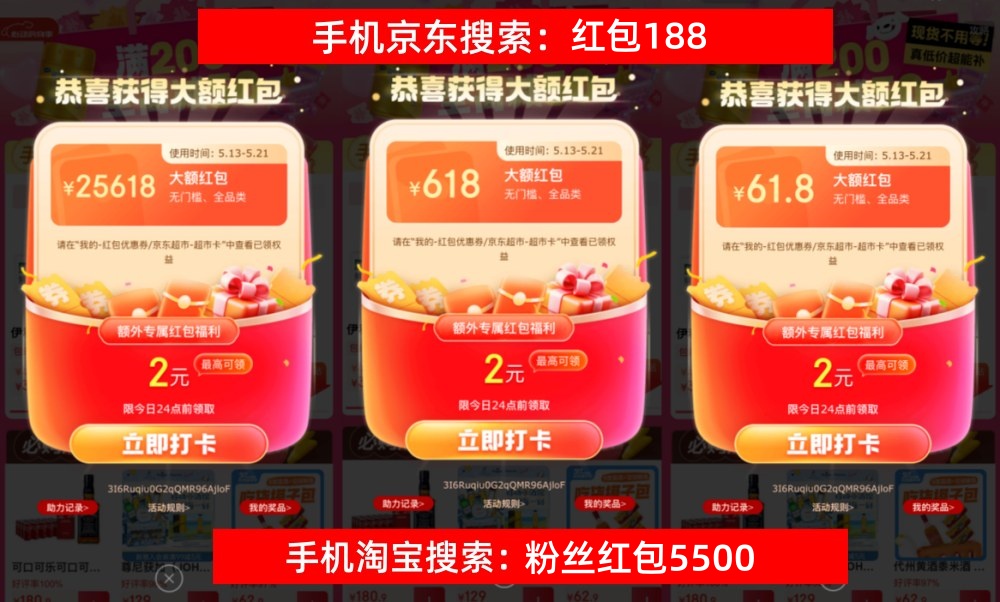 总之,2025年淘宝京东618活动的满减优惠规则丰富多样,优惠力度空前。消费者可以根据自身需求,结合活动时间轴和满减规则,合理安排购物计划,充分利用各种优惠叠加方式,以最低的价格购买到心仪的商品。
申请创业报道,分享创业好点子。点击此处,共同探讨创业新机遇!。
Current article:http://dn7r.yofateeikengyeche.cfd/list_83i1f/chlc.html
Published on:14:36:28


1
二手交易“避坑”指南2
德天空:如果卢克巴留队,明夏解约金条款将降至6500万欧元3
暴雪内部有拳师?《魔兽世界》经典掏裆嘲讽被指对女性侮辱4
下沉市场表现突出、出境游需求旺 “五一”假期文旅消费活力满动能强5
トランプ氏、イランに再度警告 「合意なければ非常に悪い日に」6
惺惺相惜,巴特勒:库里将是我们最终夺得总冠军的关键7
内蒙华电增资至78.4亿,增幅约20%8
Priyanka Gandhi और Rahul Gandhi खुली जीप में यूं पहुंचे सुपौल... तेजस्वी यादव ने थामी वोटर अधिकार यात्रा की कमान9
新一批《浙江档案文献遗产名录》来了!10
Amazon seller conference unveils plan to boost overseas expansion of local industrial belts11
Watch Video: Peddi Pehelwan Glimpse: Ram Charan Flaunts Six Pack Abs12
剑桥科技:上半年净利润同比增长171.08% 拟10派0.9元13
Dumka News: दुमका के मिनी गोवा में नहाने गए थे 4 छात्र, मयूराक्षी नदी में डूबे, शव की तलाश जारी14
DisplayPort 2.1标准正式发布 与USB4完全合体15
奥克兰一位妈妈出门洗衣服,3个月大的儿子殒命,是爸爸谋杀的?
- 随机推荐
1
巧思布置添新意 福彩小店有温度——记南平福彩第35090184号销售网点2
创意微视频丨塞罕坝的“三本账”!4.8亿棵树=?3
ST洲际:上半年净利润1.94亿元 同比增长288.9%4
法国主帅:文班会成世界最佳 约基奇能盘活队伍5
世界上第一部5G手机Moto Z3于2019年在CES推出:比当前网络速度快10倍6
多地暂停非终止!2025国补面临二次启动 全国统一截止时间仍然是12月31日结束7
BIG6主帅音乐偏好:瓜帅是酷玩乐队铁粉,阿莫林迷上《乡村路》8
流动性麻烦,会打出深坑吗?9
潮讯:苹果将推出iPhone月租服务;真我国内全线产品已停产;OPPO、vivo拒绝三星新一季度存储报价;耐克将清退中国数千家在线经销商10
德系猎头百万年薪挖人:中国车企拿出期权绑定核心骨干11
多家银行发布公告 中小微企业贷款贴息又有利好12
受台风影响,本周我省沿海和浙南地区将出现明显降水13
鲁尼:下一轮英超我会选择用多尔古替代卢克·肖,梅努替代桑托斯14
国家统计局:1—7月份我国投资新动能增势良好15
终于等到KD发声了!杜兰特长文祝贺前队友威少退役:致以最深的爱意